One Legal Question
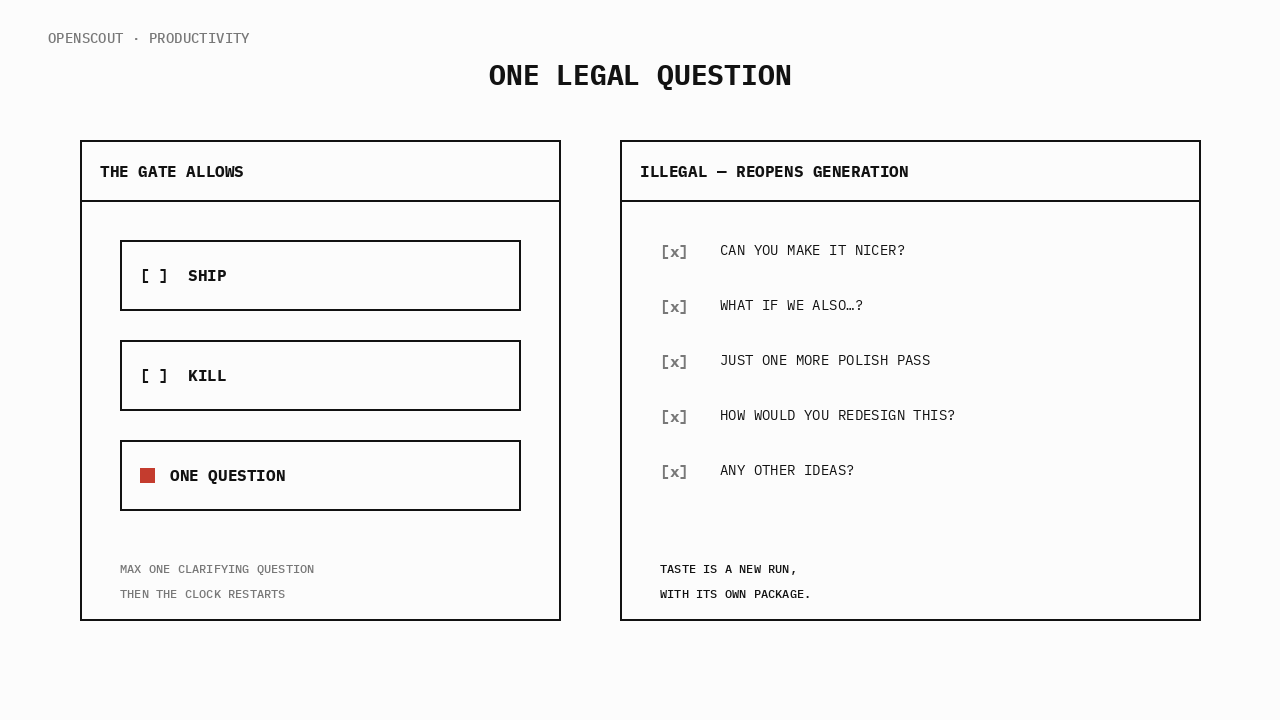
The gate allows one clarifying question — taste reopens generation
A review gate without a question budget collapses into endless polish.
You meant to decide. You asked “can you make it a bit nicer?” The agent reopened generation. The package aged. The clock you set for a decision became another session in disguise.
The rule is narrow: ship, kill, or one legal question. Anything that relaunches taste or scope is illegal at the gate.
What the gate allows
After the package is complete and the timer is running, you may do exactly one of three things:
- Ship — done-when met, verify passed, accept the tree
- Kill — stop, roll back or delete the branch, write why in one line
- Ask one question — a clarifier that unlocks ship or kill, then restart the clock
One question means one. Not one per file. Not a thread of follow-ups dressed as a single message.
Legal vs illegal
Legal questions check the package. Illegal questions reopen generation for preference.
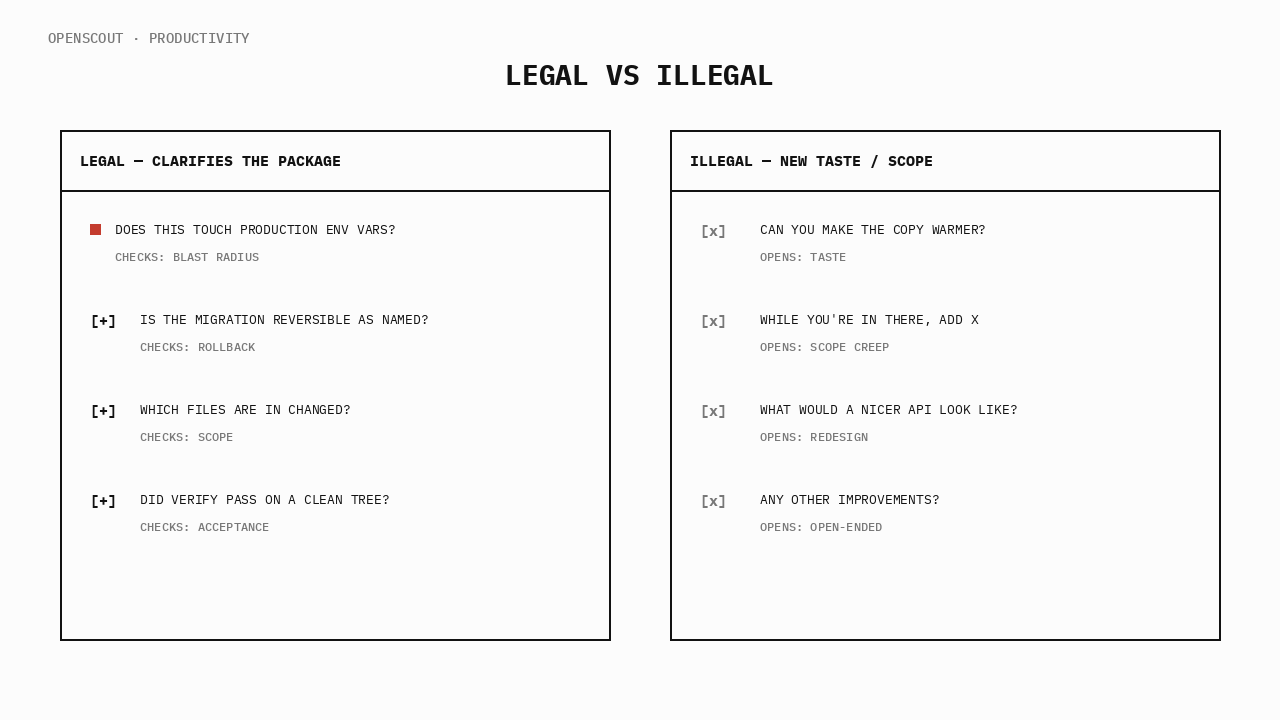
Legal (clarifies the still frame):
- Does this touch production env vars?
- Is the migration reversible with the rollback you named?
- Which paths belong under what changed?
- Did verify pass on a clean tree?
Illegal (new taste or scope):
- Can you make the copy warmer?
- While you’re in there, add X
- What would a nicer API look like?
- Any other improvements?
Illegal is not immoral. It is out of order. Taste and redesign are real work — they get their own outcome card, their own run, their own package. They do not steal the ship-or-kill clock.
How to ask the one question
Write it on the package. Name the owner. Stop the agent until the answer lands. When the answer arrives, update the relevant field (usually verify, unchanged, or rollback). Then restart the two-minute clock — or your gate’s clock — from the top.
Do not answer your own illegal urge mid-gate by “just poking the agent.” That is a new run. Schedule it. Keep the current package frozen.
If you need two clarifiers, the package was incomplete. Send it back for packaging before the gate starts. The question budget is not a substitute for fields.
What counts as done at the gate
Done is a decision recorded on the package: shipped, killed, or one written question with an owner. “I’ll think about it” is not a decision. “Maybe polish later” without a new card is not a question — it is a leak.
When the illegal urge is strong, write the new done-when in one line and park it. Finish the current gate first. Context-switch on purpose, not by accident.
Where it usually breaks
Question smuggling: one message with five asks. Count the question marks. Split or send back.
Taste as “UX bug”: if done-when never named the aesthetic bar, you are inventing acceptance mid-review. Illegal. New card: “three layout options ranked.”
Soft kill: you neither ship nor kill; you ask for another pass. That is a new run — label it. Do not pretend the gate continues.
No owner on the question: the clarifier sits in chat with nobody to answer. Write the owner on the package or the question does not count.
A few sharp edges
Design critique sessions are allowed. They are not this gate. Different done-when — for example, ranked options — different clock.
“One legal question” is compatible with pair review. Two reviewers do not get one question each by default. They share the budget or they are doing a different ritual.
If a clarifier reveals the outcome was wrong, kill. Do not patch the goal silently and keep shipping under the old card.
Generation will keep offering another pass. The gate’s job is to make “nicer” pay full price: a new package, a new run, a new decision — not a free reopen at the finish line.